Showing posts with label chickens. Show all posts

Thursday, January 21, 2010

Mulch Basin

Jeez, it's been almost a month since I posted anything. It's not that nothing is going on, I just didn't blog. Now all two of my readers will have forgotten by now. I started this post a while back, before the rain, which is pooling on the clay in the back:


 but draining where the mulch basin is:


We have a break from rain so we are taking the opportunity to dig great big holes in the clay soil of the backyard.  Last winter, just after we bought this place, I noticed that the drainage out back was pretty slow.  After heavy rain, water would sit there on the surface for a while before it would percolate into the ground.  I had been reading books like Rainwater Harvesting for Drylands and Beyond by Brad Lancaster and Create an Oasis with Greywater by Art Ludwig and they both stress the importance of mulch basins.

When I first started thinking about rainwater collection, I imagined having a storage tank holding the water from my roof.  While I do plan on doing that (I have already started collecting containers) there is no way I can store the 6000 plus gallons that might run off my roof this year.  In fact, I figure if I put a roof over a little more of the chicken coop I could get about 600 gallons from that alone.  What these books promote, especially Brad Lancaster's, is harvesting rainwater in the landscape.


A mulch basin is a big hole dug out of the earth that is filled with something like wood chips. If you have a greywater system, you can safely discharge your bath or laundry or sink water into a mulch basin.  I heard that the California Plumbing Code was changed, due to emergency water conditions, to allow domestic greywater.  In fact, it looks like the city of Petaluma is even promoting it. At any rate, even if you just want to harvest rainwater, a mulch basin seems to be a terrific idea.

We needed to get a couple of stumps removed so I called various tree people.  It would be cool and manly to have a chainsaw, but we live in the suburbs and don't need to cut that much wood.  For pruning, we have pruning saws and even a reciprocating saw with a pruning blade. A tree service guy came by and gave me an estimate. I also asked about wood chips and he said, no problem.  He showed up 2 days later and dumped a few yards of wood chips by the driveway for free. Well that was great, but we never could get him to show up and remove the stumps. I guess it is back to the phone book.

Our yard is fairly flat.  There is a very gentle slope, in that is seems like they made the street lower than the houses when they developed this walnut orchard.  Due to the poor drainage they put all the houses on little hills, but this must have been a river bed in ancient times. As you may have seen in a recent episode of Chicken Theater, the poor chickens get clay all over their feet when it rains. We have been digging out the basins and creating berms on the sloped areas, to slow the water and encourage percolating rather than runoff.  So many people try to get the water to run into the street, but we have been planting a mini orchard and want the water to stay (just away from the house, please).  I am hoping that filling the basins with wood chips will help the water to drain deep into the ground.  I am also hoping that covering the ground in the chicken area with wood chips will help condition the clay soil and mitigate the clay shoes effect while providing a habitat for worms and other creatures the chickens like to eat.  It may take many truckloads of chips.  I will keep you posted on whether it makes a difference.

Another side effect of this project is a total body workout.  Digging heavy wet clay trenches and basins really works out your abs, upper body and even your legs.  I think this will be my workout regimen from now on.  Digging holes and moving dirt.

Wednesday, December 9, 2009

Still Laying


The chickens have slowed down, as they always do this time of year, but they are still laying.  Usually, they slow down and stop altogether shortly before the solstice.  Then, like clockwork, they start up again a few days after the solstice.  I am wondering if they are getting some street light here in town.  I will keep an eye on the situation, as we still have a couple of weeks to go.

Tuesday, December 8, 2009

It's not un-Yuzu-al


This Yuzu tree has survived a few winters and a move from our last place to here.  Now that it is in the ground, it is much happier than it was in a container. Finally we have a decent number of ripening fruits. Yuzu is a Japanese citrus and you don't eat it, but you can yuze it to make ponzu, which we have with nabe, a hot pot dinner which is great during winter.

I have my eye on our cocktail grapefruit which has a bunch of nice sized green fruits on it.


It is hanging out under plastic sheeting to keep it safe from frost.  The chickens are also under there, next to an orange tree, to keep out of the rain.  Sometime we will build a more permanent structure for rain and frost because I don't like using the plastic (I am re-using it though).


Monday, December 7, 2009

Avocado Drama

As I mentioned in a previous post, I planted a couple of Mexican Avocado trees in the corner of the garden.


The pieces of concrete are there to keep the chickens from digging up the roots and to maybe provide a touch of thermal mass for frost protection.  We did just have a 28 degree killing frost the other night that finally did in a few squash, potato and tomato plants that were still hanging around but the avocado trees did fine with no additional protection. I will be covering them after the rain passes just in case.

Anyhow, after I planted them, I was googling something about avocados and stumbles upon frightening warnings of toxicity. I read that avocado leaves, stems, skin and pits were toxic to dogs, birds and other pets. Yikes! Fortunately the dog cannot get into the chicken/fruit tree area but chickens are birds, right? I looked and looked specifically for information about chickens and found speculation on chicken keeping websites, but no hard evidence. Then I found this farm blog where they are using chickens to control grass and weeds between rows of avocados.  If you read the comments section of that post, you can see my question and the farmer's answer. She has never seen any evidence of toxicity and all kinds of other birds hang out in the trees. That made me feel better.  The other thing that has made me calm down about it was some nice folks at the California Rare Fruit Growers, which I just joined. Specifically, Julie Frink (avocado expert) wrote:

    "Mexican avocado leaves can be used as tea or flavoring when roasting meats. They can be eaten skin and all.  It is the Guatemalan varieties that have toxic leaves and seeds.  One of my friends tried to feed her chickens avocados but they wouldn't eat them.  Later she found out that birds should not eat avocados.  Our neighbors dogs eat avocados all the time.  Some cats love avocado and I've never heard of it hurting them.  I wouldn't think a chicken would be tempted to eat an avocado leaf and certainly not a seed.  As to pecking on a fruit.... We have birds in our fields some of whom make nests and raise families but I've never seen birds eat avocados and we have ripe ones on the ground all the time.  Our coyotes are beautiful with healthy coats from a diet of rabbits, squirrels, rats and avocados.  The squirrels, possums, raccoons, rats and mice like to visit us to fill their tummys with avocado.  I suspect you have nothing to worry about but you could check bird and chicken fanciers.  I'll ask my two friends who have chickens what experiences they've had."


I am guessing the chickens will be uninterested in the leaves, since they are kind of tough, although that doesn't stop them from eating fig leaves. I have decided to leave the avocado trees where they are. If it becomes a problem, I can always build a fence around them.


Tuesday, October 20, 2009

Chicken Theater- Chickens, Collards, Clay

When it rains, the clay gets sticky and forms little clay shoes on the chicken feet. Meanwhile, there is a drama concerning the collard greens.

Tuesday, October 6, 2009

Chicken Theater and Fruit Trees

It turns out this is a great time of year to look for sales at nurseries.  We went to Dig Nursery in Cotati the other day and they were having a clearance sale of 30-50% off.  The guy who runs that place is very nice, by the way.  We got a large Granny Smith apple tree and a Fuji apple tree for 50% off.  Such a deal!

Then a woman in the neighborhood stopped by our door to tell us she'd been noticing our garden and that she had some extra mulch in her driveway.  We had a couple of other trees (Asian pear and a late orange) and that we had been meaning to plant so today was all about digging holes, removing a stump, walking the wheelbarrow around the neighborhood several times and shoveling things.  It is a great workout, especially upper body and abdominals.

Here are the trees in the back if you can discern them from this picture.  In the future, we will be fruit rich fruit-cakes.  Also picked up a banana tree that claims to be hardy to 10 degrees.  I put it in a bigger pot so we will see if it survives.  For the time being I can at least say, "yes, we have no bananas".


Anyhow, every time there is a hole being dug, Halley the chicken is in the middle of it.  Literally.  She is a smart chicken and knows that holes and trenches being dug means worms and other tasty morsels and she is apparently unafraid of shovels.  Please enjoy this latest installment of Chicken Theater, "Chicken In A Hole".

Saturday, September 19, 2009

Chicken Theater Episode 2

Even chickens need to take a break on the park bench.

Thursday, September 17, 2009

Chicken Theater

Welcome to Chicken Theater.  Please do not expect high drama, exceptional moments of cuteness or comedy.  Chicken Theater is a meditation, a chance to relaxo and pretend you are at the rancho.  Come and get away from it all with Flo, Shortcake, Cupcake, Butterball, Halley and Simon.

Wednesday, September 2, 2009

Cupcake


Freedom isn't free, Cupcake!

This is Cupcake, sister of Shortcake. Together they are the Babycakes. The babycakes, along with Simon, are Ameraucana chickens, who are smart, lay cool bluish-green eggs and are fairly lightweight. Of all of the chickens we have had over the past several years, the best escape artists have been Ameraucanas. They are magic chickens. One minute they are inside the fenced area, the next minute they are out. They don't even know what happened sometimes. We spent all this time creating a fence to keep the chickens away from the back garden and the more potentially toxic perimeter of the house. Cupcake flew up to the top of the fence and jumped over. I put another section of floppy chicken wire on top of the fence. A couple of days later, Cupcake got out again. Finally we clipped her wing, which really is like a haircut. She still gets out. I am not sure what to do. She is still enclosed by the taller wooden fence around the back yard, so she won't get out to the street, but I would prefer she stay in the chicken run. At least she is the only one who can do it.

Monday, August 31, 2009

Flo

Time to stop talking about vegetables and start talking about chickens. This is Flo. We don't know exactly how old she is anymore, but she is pretty darned old. When we moved into our last place about 4 or so years ago Flo was already there and already old. She was probably just entering henopause when we first met her. She would lay nice white eggs occasionally, but they started coming out with weird or no shells and eventually she stopped laying altogether. A couple of years ago we had some really intense heat which killed one of our hens. We have since learned that it is good practice to provide chickens with electrolytes on hot days (it's what chickens crave). Since they cool themselves down by panting, they exhale carbon dioxide and their blood can get too alkaline and whack them out pretty badly.

Anyhow, Flo looked like she was done for as well. She just melted into a dazed puddle. Even her comb was flopped over. She somehow managed to bounce back. In the meantime, we knew one of the chickens had been eating eggs. One day we caught Flo in the act. That explained her youthful new feathers and perky comb. She had become a vampire chicken! Since we are softies, we kept her around anyway and just checked the eggs as often as we could. All of the other chickens of her generation have since passed away but Flo just keeps on keeping on.

Go Flo!

Wednesday, August 12, 2009

Look At That S Car Go


It is the bad punchline to a bad joke about a snail buying a car. Cash for clunkers made me think of it. But seriously, the snails in our area are escargot snails brought here by the French. With their delicate shells it is amazing they survive in the wild. I tried escargot once but was not a big fan so I am not going to travel down the road of eating my pests. I let the chickens do that for me. They can use all the extra protein and calcium they can get and I don't have to spend weeks purging the snails.

I find an upside down flower pot is an excellent trap for them. They go in there to escape from the hot summer sun and I can just pick it up and shake it out in the chicken run. The chickens go crazy over them. I feel a little bad for the snails to meet such a brutal end, but hopefully it is fairly quick. It also means more greens to feed my chickens since the snails stay under control.

Monday, August 10, 2009

A Scorcher


How hot was it? I don't think it was really 108 degrees, but that is what the car said when I got in it. It was sitting in the sun. I think it was more like 99 degrees. I am hoping this will push the tomatoes over the hump into ripe. And maybe some melons , too?

How hot was it? I bought a new seed starting tray and left the clear lid on with no dome in partial shade and it turned into a solar oven and melted the plastic.


And the chickens were hot.

But I was able to cook some potatoes in the old solar oven. I made it a couple of years ago and it gets over 200 degrees easily. Today it was around 250. I would like to build a better one. I know you can get over 350 in a well built solar oven.


Back Yard Garden


I wrote about the garden in the front yard. This is currently the most productive part of our garden, the more attractive part and the most chicken proof part. It is also the one people see when they walk by. The one in back, our "secret garden" is growing into its own.

This picture shows Lina digging out the grass and weeds several months ago.
In between the strips of cardboard behind her is where we planted two rows of asparagus. Since then, the chickens have dug through there several times before we had our fencing in order, so we may have to put in some more crowns next year. the cactus in the background is a nopal cactus that was already here. Since it produces edible pads and fruit, we are leaving it where it is.

The biggest chunk of this garden is corn. I am still learning how to tell when it is ready. I picked some that I thought would be ready but it was immature. It was still tasty.

To the left of the corn is a sad attempt at okra. I keep trying to grow okra year after year and I am determined to get it right. This year the ants are farming aphids on them and the chickens have already attacked them a couple of times. Behind the okra are spaghetti squash, kabocha (the third year I am growing it from seeds from a friend) and yellow crookneck squash. In front of the corn is a squash I got from Baker Creek Seed Company's new Petaluma store called Long Island Cheese. It is named after its cheese-wheel appearance, not the flavor, though that would be neat.

Behind the corn is a giant Persian walnut tree (aka English walnut). This whole neighborhood used to be a walnut orchard, so every lot has a walnut tree on it. Some of the trees have been taken over by the black walnut root stock but ours has the common larger walnut on it.

If we had picked some back in June we could have made nocino, which we did a couple of years ago after our friends Carleen and Joel brought by some walnuts they picked. We made a few different recipes and it was delicious. Anyhow, the reason I am writing about the walnut tree is that having it right next to a garden plot limits the types of crops you can grow. Walnut roots and leaves are toxic to all nightshade family crops, but I read that corn, squash and beans were OK and they seem to be. Also, black walnut is more toxic than Persian walnuts.

Thursday, August 6, 2009

Roll Your Own Compost

While we started all this with a big compost purchase, I want to minimize the need to buy things like that. I considered all different kinds of compost systems. I used to have a big plastic composter with a door on the bottom, but it took so long to finish, created a habitat for slugs and ants and was constantly falling apart. I gave it up when we last moved. I thought of building a three bin system, but since it gets so dry around here, I didn't want to have to water it all the time and we also were not sure we wanted to commit to a particular location.

I had read about compost tumblers, which claim to give you finished compost in just 3 weeks . I liked the idea, but not the expensive price tag. Also, all the moving parts made me think they might break. And what if you want to stop adding stuff and start a new batch while it's still cooking?


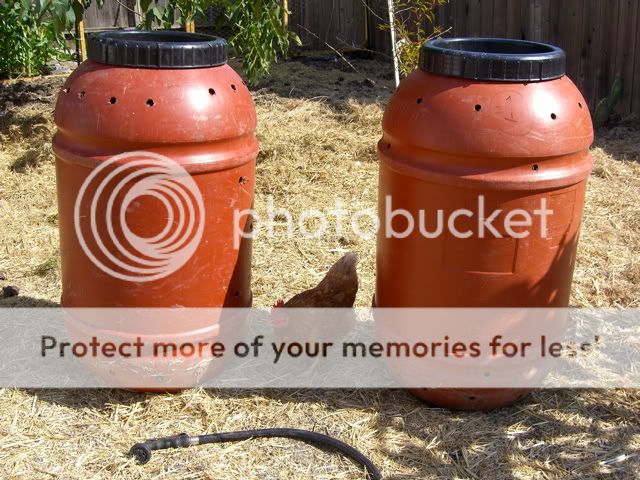
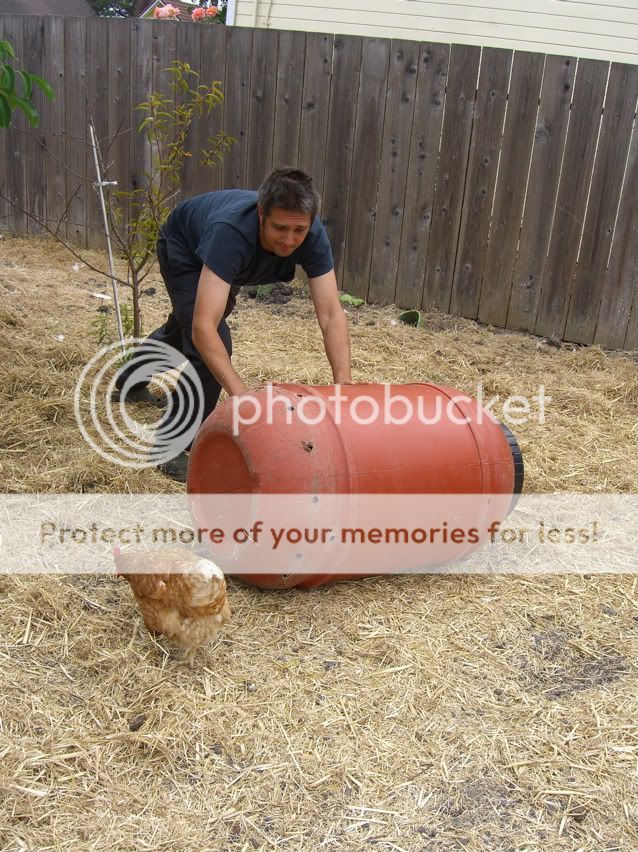
On Craigslist I was able to find food grade barrels. Specifically, I wound up going to Bataeff Salvage (I have to be careful not to buy all kinds of things there) where I found fairly un-offensive "terra cotta" colored plastic barrels that previously contained olives. These barrels are perfect for compost because they have screw on lids for easy access and moisture retention and they are only $15 each. I drilled a bunch of holes in them towards the top and bottom, to facilitate airflow.

Into the compost goes chicken dropping, kitchen scraps and garden waste. We have 2 barrels so we can let one batch finish without adding new materials while we start a new batch. All kinds of exciting compost pictures are available here. I need to start a compost calendar so I can remember when it is ready.

Perhaps in the future we will mount these on stands, but for now, we roll our own compost.


Next- COMPOST TEA!