
 Posts
Posts


We want to make our "carbon footprint" as small as possible. Solar energy of some kind seems like I good idea. I always heard that solar hot water had a much quicker payback over solar electricity. There is a 30% federal tax credit available and the California Energy Commission is offering rebates and tax credits as well. In addition to all this, California's AB 811 is kicking in and is being administered on a county level. In Sonoma County it is SCEIP and it gives you a 7% loan that gets attached to your home's tax assessment, so it is not a personal loan and if you sell the house, the loan repayment goes along with the house.
We had a couple of contractors give estimates for solar hot water and then we did some math. One thing we had not really considered was that there are only two of us and we have done some things that make our gas bill and our electric bill pretty low already.
The cheaper estimate wound up being about $6600 after tax credits and rebates. When it is warm and we are not heating our home, we use gas for hot water (showers, sinks, laundry), the dryer and the stove. It is currently about $10 per month. We insulated our pipes and wrapped the water heater. In addition the water heater is turned to a comfortable setting, but it is definitely well below maximum. At this rate it would take us 55 years to repay this investment. If I went by the March bill, which included some heating, It would be closer to 13 years, but this hot water system doesn't heat the house.
Similarly, we figured it would take 40-60 years to repay a photovoltaic system. So no matter how sexy panels on the roof are, we are definitely looking towards efficiency improvements instead.
Fortunately, all of these rebate, tax credit and loan programs apply to less glamorous upgrades, such as windows, doors, insulation, cool roofs, etc. As I have written before, insulation is a very good bang for your buck. We spent $500 on materials and got $300 from our utility. I think we may be able to apply the federal tax credit to that as well.
One improvement we made that I do not think is covered by these programs, but is very exciting is the installation of high efficiency, long lasting LED recessed lights. We bought the Cree LR6 lights, which have regular edison bases and can be screwed into many off the shelf recessed light fixtures. We have been very impressed with the amount and quality of light these produce for only 12 watts. I wish they came in light bulb form, but they have these heat sinks on them, which makes them a little bulky for an ordinary lamp. They are a little pricey at $80-90 each, but they last for decades, contain no mercury and are dimmable. If you do the math, it has a fairly quick payback, even compared to CFLs. The only thing that makes me grumble is that they do a lot of stuff for the military (including installing thousands of these LED lights). The military is thinking ahead, though. The Pentagon issued a report back in 2004 warning of the chaos that climate change could bring. The military is also a big user of solar panels, etc. So many of the innovative products we will see will also likely have a military use. It's great that the military wants to reduce its carbon footprint, but we really need to reduce our military footprint around the world.
Other improvements we can make include upgrading our heat (currently gas wall heater) to a hot water radiator system, wearing sweaters in the winter, replacing our front door, air drying our laundry, DIY solar hot water heater (may be less efficient than commercial, but lower investment), re-roofing the leaky garage roof with a lighter color and insulation (cool roof) and so much more.
We have some more head scratching to do, but if we plan well, we can get our future energy bill savings subsidized now .
Next: Back to the garden!
Tuesday, August 11, 2009


Monday, August 10, 2009
A Scorcher

How hot was it? I don't think it was really 108 degrees, but that is what the car said when I got in it. It was sitting in the sun. I think it was more like 99 degrees. I am hoping this will push the tomatoes over the hump into ripe. And maybe some melons , too?
How hot was it? I bought a new seed starting tray and left the clear lid on with no dome in partial shade and it turned into a solar oven and melted the plastic.

And the chickens were hot.

But I was able to cook some potatoes in the old solar oven. I made it a couple of years ago and it gets over 200 degrees easily. Today it was around 250. I would like to build a better one. I know you can get over 350 in a well built solar oven.

Back Yard Garden

I wrote about the garden in the front yard. This is currently the most productive part of our garden, the more attractive part and the most chicken proof part. It is also the one people see when they walk by. The one in back, our "secret garden" is growing into its own.
This picture shows Lina digging out the grass and weeds several months ago.
 In between the strips of cardboard behind her is where we planted two rows of asparagus. Since then, the chickens have dug through there several times before we had our fencing in order, so we may have to put in some more crowns next year. the cactus in the background is a nopal cactus that was already here. Since it produces edible pads and fruit, we are leaving it where it is.
The biggest chunk of this garden is corn. I am still learning how to tell when it is ready. I picked some that I thought would be ready but it was immature. It was still tasty.
 To the left of the corn is a sad attempt at okra. I keep trying to grow okra year after year and I am determined to get it right. This year the ants are farming aphids on them and the chickens have already attacked them a couple of times. Behind the okra are spaghetti squash, kabocha (the third year I am growing it from seeds from a friend) and yellow crookneck squash. In front of the corn is a squash I got from Baker Creek Seed Company's new Petaluma store called Long Island Cheese. It is named after its cheese-wheel appearance, not the flavor, though that would be neat.
Behind the corn is a giant Persian walnut tree (aka English walnut). This whole neighborhood used to be a walnut orchard, so every lot has a walnut tree on it. Some of the trees have been taken over by the black walnut root stock but ours has the common larger walnut on it.

If we had picked some back in June we could have made nocino, which we did a couple of years ago after our friends Carleen and Joel brought by some walnuts they picked. We made a few different recipes and it was delicious. Anyhow, the reason I am writing about the walnut tree is that having it right next to a garden plot limits the types of crops you can grow. Walnut roots and leaves are toxic to all nightshade family crops, but I read that corn, squash and beans were OK and they seem to be. Also, black walnut is more toxic than Persian walnuts.
Saturday, August 8, 2009
Compost Tea

Now that we have a compost system and a new batch of compost, I want to use it, but all the garden is in cultivation, so I don't want to mix it into the soil. Someone suggested I make compost tea, so I looked it up on the google machine.
I had most of what I needed, buckets and compost, but I didn't have an aquarium bubbler or tubing. I took a stroll over to my local stripmall and found a big chain pet store that had what I needed.
I followed the instructions I read at the Pennsylvania Department of Environmental Protection and I was all set. Here is my first batch of compost tea bubbling away.
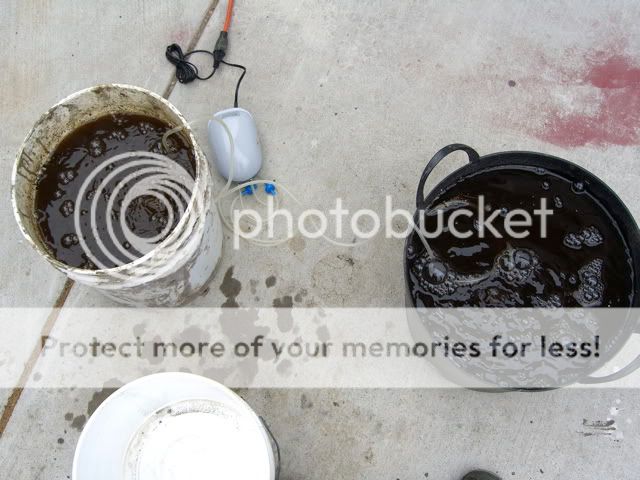 I just watered everything with it and the weather's getting hotter so we shall see what happens.
Thursday, August 6, 2009
Roll Your Own Compost
While we started all this with a big compost purchase, I want to minimize the need to buy things like that. I considered all different kinds of compost systems. I used to have a big plastic composter with a door on the bottom, but it took so long to finish, created a habitat for slugs and ants and was constantly falling apart. I gave it up when we last moved. I thought of building a three bin system, but since it gets so dry around here, I didn't want to have to water it all the time and we also were not sure we wanted to commit to a particular location.
I had read about compost tumblers, which claim to give you finished compost in just 3 weeks . I liked the idea, but not the expensive price tag. Also, all the moving parts made me think they might break. And what if you want to stop adding stuff and start a new batch while it's still cooking?
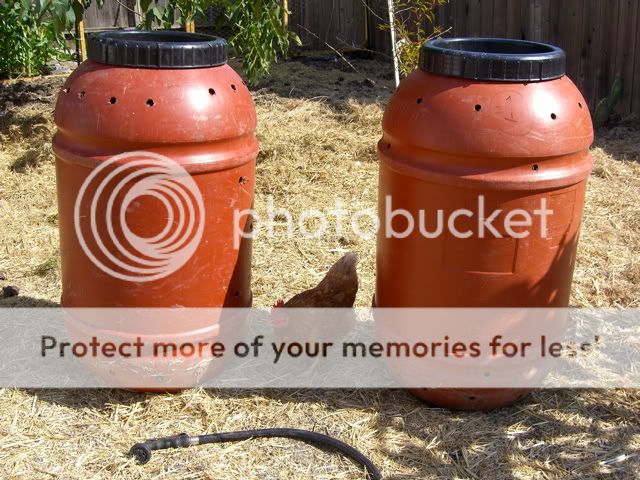
On Craigslist I was able to find food grade barrels. Specifically, I wound up going to Bataeff Salvage (I have to be careful not to buy all kinds of things there) where I found fairly un-offensive "terra cotta" colored plastic barrels that previously contained olives. These barrels are perfect for compost because they have screw on lids for easy access and moisture retention and they are only $15 each. I drilled a bunch of holes in them towards the top and bottom, to facilitate airflow.
Into the compost goes chicken dropping, kitchen scraps and garden waste. We have 2 barrels so we can let one batch finish without adding new materials while we start a new batch. All kinds of exciting compost pictures are available here. I need to start a compost calendar so I can remember when it is ready.
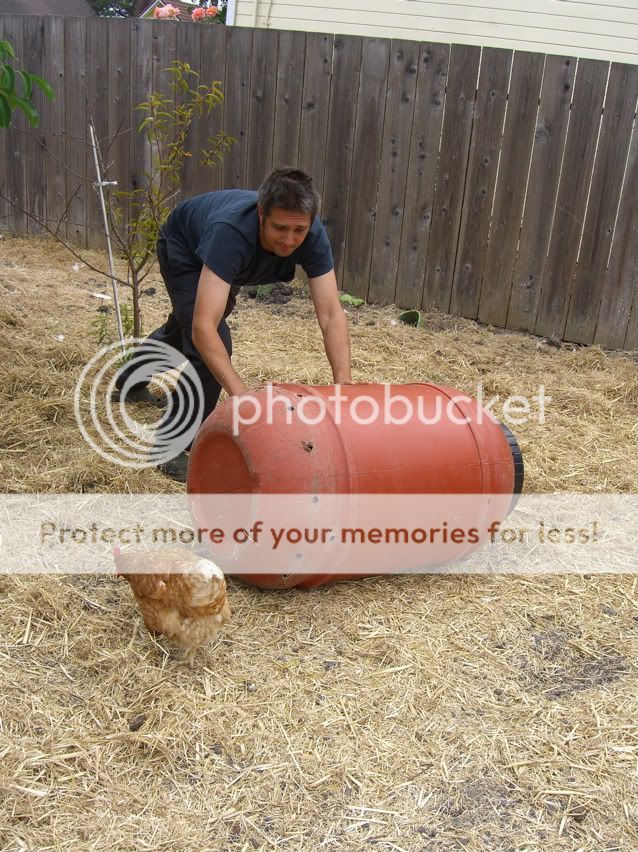
Perhaps in the future we will mount these on stands, but for now, we roll our own compost.
Next- COMPOST TEA!
I had read about compost tumblers, which claim to give you finished compost in just 3 weeks . I liked the idea, but not the expensive price tag. Also, all the moving parts made me think they might break. And what if you want to stop adding stuff and start a new batch while it's still cooking?
On Craigslist I was able to find food grade barrels. Specifically, I wound up going to Bataeff Salvage (I have to be careful not to buy all kinds of things there) where I found fairly un-offensive "terra cotta" colored plastic barrels that previously contained olives. These barrels are perfect for compost because they have screw on lids for easy access and moisture retention and they are only $15 each. I drilled a bunch of holes in them towards the top and bottom, to facilitate airflow.
Into the compost goes chicken dropping, kitchen scraps and garden waste. We have 2 barrels so we can let one batch finish without adding new materials while we start a new batch. All kinds of exciting compost pictures are available here. I need to start a compost calendar so I can remember when it is ready.
Perhaps in the future we will mount these on stands, but for now, we roll our own compost.
Next- COMPOST TEA!
Wednesday, August 5, 2009
The Water Bill
Since it was so very hot several weeks ago, we had to water the garden. Since we have a lot of new compost and rapidly growing plants, the soil was thirsty. In our last place we were on a well with septic, so it is a new thing to pay water bills. It is also new to pay sewer bills.
In Petaluma, your sewer bill is based on the winter average. Since it rains in the winter and is dry in the summer, this is a sensible way to figure out how much water is going to the sewer without metering the sewer. Since we have not been here for a full year, we do not have a winter average to base our sewer bill upon. This means they look at our current water use or the average winter water usage of households in our area and bill us based on whichever number is lower. It has cooled down recently, and our soil has reached some sort of baseline water saturation, so we have been able to ratchet down the watering schedule. Hopefully our next bill will be more humane. I am hoping to get some rainwater catchment happening before the rain comes so we can reduce our pressure on local water supplies next summer.
Fortunately, even at peak watering season we are using less water than the winter average for our area. Unfortunately, the sewer rate is about twice as expensive as the water rate and I know our winter usage will be much lower. It was pretty pricey to water the garden this summer because we are subsidizing the new waste water treatment facility, which I am pretty OK with because...
The other day, we went to Shollenberger Park, which is still not saved, by the way, and we were surprised to see a fence gone and a new sign. Our park had grown to several times its original size thanks to the Ellis Creek Water Recycling Facility. I just found some pictures of it here. Who knew that waste water could be so beautiful? I hope we can take a tour inside the building as well soon.
In Petaluma, your sewer bill is based on the winter average. Since it rains in the winter and is dry in the summer, this is a sensible way to figure out how much water is going to the sewer without metering the sewer. Since we have not been here for a full year, we do not have a winter average to base our sewer bill upon. This means they look at our current water use or the average winter water usage of households in our area and bill us based on whichever number is lower. It has cooled down recently, and our soil has reached some sort of baseline water saturation, so we have been able to ratchet down the watering schedule. Hopefully our next bill will be more humane. I am hoping to get some rainwater catchment happening before the rain comes so we can reduce our pressure on local water supplies next summer.
Fortunately, even at peak watering season we are using less water than the winter average for our area. Unfortunately, the sewer rate is about twice as expensive as the water rate and I know our winter usage will be much lower. It was pretty pricey to water the garden this summer because we are subsidizing the new waste water treatment facility, which I am pretty OK with because...
The other day, we went to Shollenberger Park, which is still not saved, by the way, and we were surprised to see a fence gone and a new sign. Our park had grown to several times its original size thanks to the Ellis Creek Water Recycling Facility. I just found some pictures of it here. Who knew that waste water could be so beautiful? I hope we can take a tour inside the building as well soon.
Mid Summer
It has been a while since I have posted.
Since I don't think anyone is reading, I don't feel so bad, but I promise to be more regular.
Summer came for a while and the garden really grew. We have been getting a good crop of Filet beans, which are like a string bean with no string. We have them in yellow and green. We have been picking every day, giving to neighbors, cooking and pickling them.
Also on the menu now are Shishito peppers. If you live in part of the San Francisco Bay Area where you cannot fully ripen bell peppers, these will make you feel good. They are compact and very prolific. You pick the peppers a few inches long, put some olive oil and salt on them and pop them in the toaster oven. Eat them, seeds and all, with beer in some other snack scenario. They are not hot, despite some seed catalog descriptions.

Our musk melons plants are making melons. I saved these seeds from melons I bought from Crescent Moon Farm at the Cotati Farmers Market a couple of years ago. I wish I could remember the names. I just labeled them Musk Melon 1, 2 and 3. Crescent Moon Farm always has really interesting vegetables like okra a nd unusual peppers. I remember one of the melons was a perfume melon with a strong fragrance but a mild flavor. It was meant to be carried in one's pocket I was told.
Another unusual thing I am growing a husk cherry. This variety is called Aunt Molly's Husk Cherry and I picked it up at a plan sale at the Occidental Arts and Ecology Center this spring, along with a bunch of tomato plants. The husk cherry is related to
 a tomatillo but the fruit is much smaller and
much sweeter. You could have it for dessert or in your salad. I am still not totally convinced that I really like them, but they are different and they are ripe now, unlike the tomatillos or tomatoes. We did get our first cherry tomatoes the other day, though, and they were great.
Other food ripening now includes zucchini, eggplant and japanese cucumbers. I am pretty surprised that the whole garden is doing so well since we didn't really get the soil ready until May.
Coming soon...
The garden in the back yard!
The water bill!
The sewer bill!
The plans for rainwater catchment!
The compost and compost tea!
And much much more...
 since I have posted.
Since I don't think anyone is reading, I don't feel so bad, but I promise to be more regular.
Summer came for a while and the garden really grew. We have been getting a good crop of Filet beans, which are like a string bean with no string. We have them in yellow and green. We have been picking every day, giving to neighbors, cooking and pickling them.
Also on the menu now are Shishito peppers. If you live in part of the San Francisco Bay Area where you cannot fully ripen bell peppers, these will make you feel good. They are compact and very prolific. You pick the peppers a few inches long, put some olive oil and salt on them and pop them in the toaster oven. Eat them, seeds and all, with beer in some other snack scenario. They are not hot, despite some seed catalog descriptions.

Our musk melons plants are making melons. I saved these seeds from melons I bought from Crescent Moon Farm at the Cotati Farmers Market a couple of years ago. I wish I could remember the names. I just labeled them Musk Melon 1, 2 and 3. Crescent Moon Farm always has really interesting vegetables like okra a
 nd unusual peppers. I remember one of the melons was a perfume melon with a strong fragrance but a mild flavor. It was meant to be carried in one's pocket I was told.
Another unusual thing I am growing a husk cherry. This variety is called Aunt Molly's Husk Cherry and I picked it up at a plan sale at the Occidental Arts and Ecology Center this spring, along with a bunch of tomato plants. The husk cherry is related to
 a tomatillo but the fruit is much smaller and
much sweeter. You could have it for dessert or in your salad. I am still not totally convinced that I really like them, but they are different and they are ripe now, unlike the tomatillos or tomatoes. We did get our first cherry tomatoes the other day, though, and they were great.
Other food ripening now includes zucchini, eggplant and japanese cucumbers. I am pretty surprised that the whole garden is doing so well since we didn't really get the soil ready until May.

Coming soon...
The garden in the back yard!
The water bill!
The sewer bill!
The plans for rainwater catchment!
The compost and compost tea!
And much much more...
Subscribe to:
Posts (Atom)